

I was given a six-month window. The biology disagreed.


I was 43 when my brain went grey on a scan.
Not grey as in ageing. Grey as in: this part is gone. That's what I understood, reading between the lines of every carefully worded clinical conversation that followed. Do the rehab. Manage your expectations. You have a window — roughly six months.
Six months. Then: this is it.
So much of how I knew myself lived in my brain. The pace of it. The way I could walk into a room and understand it before I'd found somewhere to sit. That felt like me — though maybe it was always just one version of me. And now chunks of it were showing up on scans like dead patches on a weather map.
So when someone, a few weeks into recovery, first mentioned the word neuroplasticity — I filed it exactly where I file everything that sounds like hope dressed up in jargon. Brain hacking. Executive-coach gobbledegook. Not for me.
I was wrong. And unlearning that was the most important thing I've ever done.
Here's what neuroplasticity actually is.
Your brain is not a fixed structure. It's a living network of roughly 86 billion neurons — constantly forming connections, strengthening the ones you use, pruning the ones you don't. Every skill you've built, every route you know by heart, every habit your body runs on autopilot: your brain physically wired itself to do that. Not once. Continuously.
In neuroscience, plasticity is the ability of the nervous system to adapt to experience. So neuroplasticity happens when the network forms new connections, strengthens existing ones and eliminates those no longer needed.

When two neurons activate at the same time, repeatedly, the connection between them gets stronger. Faster. More permanent. Use a pathway enough and your brain starts treating it as essential infrastructure.
That's the mechanism. Not magic. Not metaphor. Biology.

Now add a stroke to that picture.
When a stroke damages brain tissue, the connections in that area go quiet. But the rest of the brain doesn't just sit there. Surviving neurons start growing new projections to replace the lost connections. Functions that lived in one area begin shifting — sometimes to a neighbouring region, sometimes to the opposite hemisphere entirely.
The brain starts routing around the damage.
This is called cortical remapping. It's what shows up on fMRI (brain imaging scans). And before those scans arrived in the 1990s, most of neuroscience genuinely didn't believe it was happening. The working assumption for most of the twentieth century was that the adult brain was essentially fixed. What's damaged is damaged. What's lost is lost.
Then scientists watched a living brain reorganise itself in real time. They watched stroke survivors' brains light up differently after weeks of rehabilitation. New areas activating. Old functions finding new homes.
The fixed-brain model didn't quietly retire. It collapsed.
Here's the part that gets left out of most conversations about stroke recovery.
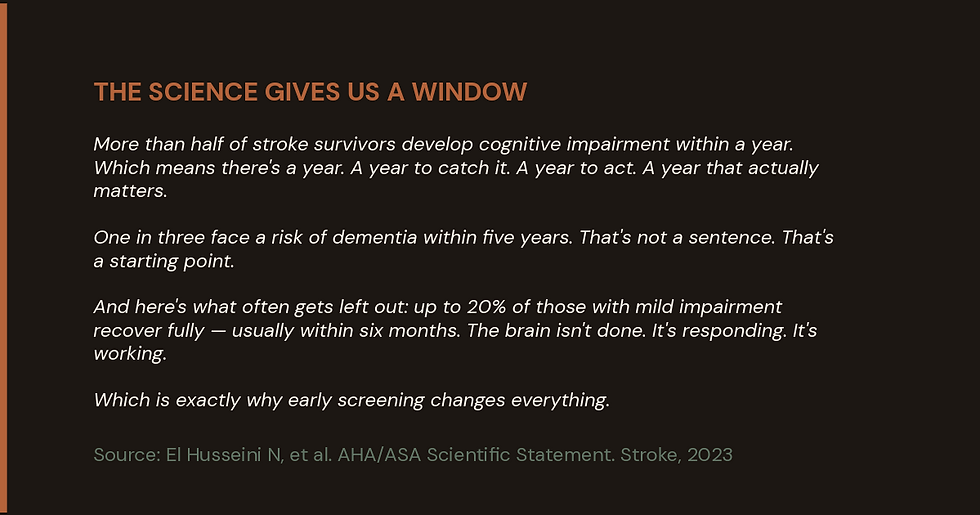
Cognitive difficulty after stroke is dramatically underdiagnosed, particularly in people who've made strong physical recoveries. Because it doesn't look the way people expect. It looks like being three beats behind in a fast conversation. It looks like reading the same paragraph four times and still not being sure you've absorbed it. It looks like the word you need vanishing mid-sentence, in a meeting, while you watch the tiny recalibration on someone's face.
You can walk normally. You can follow a conversation. You can look, to anyone who didn't know you before, like someone doing absolutely fine.
Executive function is the brain's management system. Planning. Holding a thread. Moving between tasks without losing the plot. It's the part of you that runs the complexity of a normal day — and it's one of the first things stroke can quietly dismantle.
Between 25% and 75% of stroke survivors experience some impairment here (El Husseini et al., 2023). That range isn't vague. It's telling. The more precisely researchers look, the more they find.
Standard assessments miss a lot of this. People living it don't.
For most of the twentieth century, medicine gave stroke survivors a ceiling. A timeline. A version of recovery and then: that's it.
Neuroplasticity doesn't promise otherwise. But it does establish something important — that the brain you have today is not the brain that exists at the limit of what's possible. That the mechanisms for change, real biological change, don't disappear after six months. That the window the science once assumed slams shut is considerably more open than we were told.
The brain that went grey on my scan is not the brain I have now. I can't prove that in a way that would satisfy a clinical trial. But the science that told me it was biologically possible gave me somewhere to put my refusal to accept a ceiling.
That's what neuroplasticity is, at its most honest. Not a cure. Not a promise. Just the biological evidence that the story isn't over.
For me, that was enough to start asking different questions…
Not better questions, necessarily. Just different ones. Less is this it and more what haven't we tried yet.
That shift — from ceiling to opening — didn't come from a conversation with a consultant. It came from understanding the biology. From knowing that the brain reorganising itself wasn't a metaphor someone had invented to make me feel better. It was happening. On scans. In labs. In the recoveries of people who'd been told, just like me, that the window had closed.
If you want to understand the science more deeply — not the jargon, the actual human story of it — Norman Doidge's The Brain That Changes Itself is where I'd start. It won't tell you what to do. But it might change what you think is possible. And sometimes that's the thing that moves first.
Sources: AHA/ASA Scientific Statement on Post-Stroke Cognitive Impairment (2023) · Patel, Shim & Agrawal (2025), Archives of Internal Medicine Research · Aderinto et al. (2023), Annals of Medicine & Surgery · Gunduz, Bucak & Keser (2023), Journal of Clinical Medicine


Comments