

A User's Guide to Not Having It All

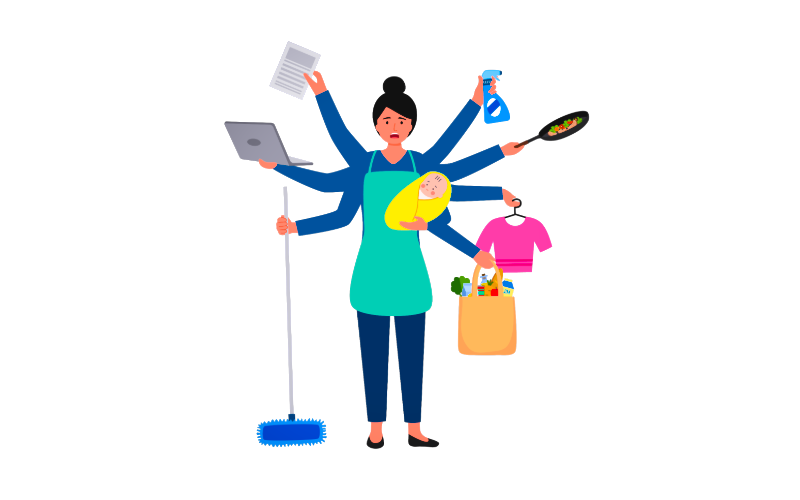
I was raised by a mother who told me I could have it all. A brilliant career, a loving relationship, a picture-perfect home, and a fulfilled experience of motherhood. Maybe even a dog thrown in for good measure.
It was a story told by many mothers from the women’s movement, and it sounded good to my generation. We grew up believing that with plenty of effort and careful organisation, every aspect of our lives would fall neatly into place.
But that promise, that women can “have it all”, has never actually materialized.
The truth is that early feminists from the 1970s, our mothers included, handed down expectations that were never realistic. There have never been more women in the workforce than there are now. And so many of us are made unhappy or unwell by the pressure to meet our unrealistic expectations.
For each of us the pressure feels different. Some opt out of their careers after discovering that work-life balance isn’t just difficult, it’s fundamentally unattainable. Others rely on nannies to keep the plates spinning, the house, the children (and that dog if we’re lucky!). Many of us live with a low-level fear that someone will notice our home looks less like the glossy interior spread and more like the aftermath of a tornado.
In my case, it was my body that paid the price for trying to have it all.

When I had my stroke, everything fell apart. The first thing to go was my identity as a professional. I hadn’t realised just how much of my energy I had been giving to work, or how completely I had come to define myself by it. My entire sense of self was wrapped up in my brilliant brain and in where it could take me. I was bright, quick, intelligent. I’d been the girl who worked hard at school, got top marks, and carried that same sense of myself into adulthood. Professional achievement was my way of making sense of the world.
Even after becoming a parent, a large part of my mental space remained occupied by work. When I was at home, playing with the kids, I was multitasking. Building lego structures while thinking about the emails I needed to send, the project I needed to get finished. I lived in my head, through thought and planning and output. I understood myself primarily as a cerebral being, and I measured my worth through the life of the mind.
After my stroke, all the balls I had thought I was juggling with ease came crashing down. Tasks that had once felt routine became impossible. I couldn’t manage the daily commute because of sensory overload. The noise, the speed, the press of bodies and the constant motion of daily life were more than I could process. I struggled with depth perception and stepping onto and off the train felt like a huge challenge. Panic attacks followed, sudden and disabling.
At the same time, I was desperate to hide how vulnerable I had become. I didn’t want my colleagues to see me struggle. If their perception of me changed, I didn’t know how I would ever return see myself once again as the cerebral person I had always understood myself to be.
Early recovery stripped everything back. I couldn’t do anything. I was completely exhausted in a way I had never experienced before, a kind of fatigue that made even simple decisions feel weighty. I wanted complete sensory deprivation from family life, from noise, from questions, from being needed. And that in itself was confronting, because I had always prided myself on coping.
What became painfully clear was how much energy I had been spending simply trying to “get up and get on with it”. I had treated resilience as a moral virtue rather than a finite resource. My body, it turned out, had indeed been keeping score.
When my kids were little, I had what felt like a huge and ugly secret. I wasn’t a particularly good mother. I found nurturing and playing exhausting, even before the stroke I thought my exhaustion was proof of failure. That if I were doing motherhood properly, it would feel more natural, more joyful, more like the adverts.. I complained often, blaming society for asking too much of parents, which wasn’t wrong, but also conveniently allowed me to avoid a harder truth. Parenting felt like a job with no clear metrics, no promotions, and very little positive feedback. Work, by contrast, rewarded effort. So I threw myself into it.
After the stroke, I came to grieve the mother I thought I was supposed to be. The endlessly capable, softly smiling version who manages to pack organic lunches while remaining emotionally available and somehow running a meeting at the same time.
But I also stopped believing in that superhuman narrative. Finally I realised that there’s a price to be paid when you strive for perfection.
Something unexpected came out of my recovery. The stroke gave me permission to have boundaries I’d never had before.When I was too fatigued to play, I no longer felt that I was failing my children. I began to see that part of my job was not to smooth every edge of their lives, but to help them develop some resilience of their own. Children don’t need to be wrapped in bubble wrap. They need to learn that care includes limits. I am there for the important things. I am just not there for everything, all the time.
My children understand those boundaries better than I expected. They know I struggle with loud noise, bright lights, competing sounds and chaos, which is unfortunate, as chaos is very much their brand. We talk openly about it, usually explained as “because mummy has a brain injury”, which they accept with far more grace than most adults. They understand that sometimes I need them to be quieter and calmer. They also know when it’s time to go and find dad, who is far better equipped for early mornings, football training and shouting encouragement from the sidelines.

The stroke also changed my relationship with keeping up. Before, I had absorbed the idea that childhood was a series of preparatory steps towards something else. The next stage. The next opportunity. The next advantage. We create enormous stress around education and activities, often in the name of future success. After the stroke, my understanding of childhood changed. I want my children to be present and to enjoy what they’re doing now. Extra lessons feel unnecessary if a child is neither happy nor particularly interested. Gaming presents its own pressures, mainly around keeping up with conversations at school. Sometimes, it is important to let children sit with the discomfort of not keeping up. It turns out that’s a useful life skill in itself.
The stroke forced me to confront how much of life is spent preparing for something else. My parents worked hard to give me opportunities, and I’m incredibly grateful for that. But my father worked relentlessly towards a retirement he never reached. He died at fifty-five, after decades of planning for a future that never arrived. I would trade many of those opportunities to have had more time with him. Being present is not something you make room for later. It is the thing itself.
People often ask what my children have lost. I don’t think they have lost anything significant in a material sense. They experienced a traumatic event, and each of them processed it differently. They had to grow up faster than I would have liked. My son worries more than he used to. Some childhood innocence was lost. That’s all true, and hard to look at.
But they’ve also gained things I didn’t anticipate. They’ve seen how much work it takes to recover, and how priorities can change. They’ve developed empathy and an ability to read the room with unnerving accuracy. They understand the importance of talking about things rather than letting them fester. They know that each parent has different strengths. I’m the planner. Dad’s the morning person. They know who to go to for which problem, and that is not a small thing.
What should replace the “have it all” narrative? That’s a good question. And one millions of women the world over are trying to answer. To me it’s simple. Community. Support. The understanding that no one exists in isolation, no matter how competent they appear on the outside. And certainly no matter how perfect their life looks on social media! We need to surround ourselves with people who us as we really are. In the good and the bad moments. Many friends didn’t even realise I had had a stroke because they only saw me when I was capable of putting on a convincing game-face. The people who support you day to day see the reality. They see the limits and they help anyway.

Stripping away performance has left me in unfamiliar territory. I am still working out who I am without the constant need to prove myself intellectually. I recently learned the word polymath. The idea that we don’t have to be conversant in one thing but instead can explore many. And in my life I have to admit that some are done well, some badly! I have given myself permission to fail, to drop the ball, to accept that I have butterfingers. It turns out this makes me significantly kinder to myself.
What I want my children to learn about life is simple. Everything takes work, but you don’t have to do it alone. Independence can be useful, but so is knowing when to ask for help. And you don’t have to have it all to be happy. Just enough – that’s all it takes.
If I could speak to my pre-stroke self, I would tell her that none of this matters if you’re dead or incapacitated. Values and priorities are not abstract ideas, but health decisions. That life needs balance across physical health, mental health, rest, family, fun and nourishment. Cut one strand and the whole thing weakens. I would tell her not to wait to be forced to stop. Tragedies happen. If today were your last day, you would want clean pants, a good meal, and at least one genuine smile.
For mothers to stop being expected to be superhuman, something has to change. Culturally, we need to move away from the relentless push to earn more, buy more, do more. We need to move away from the perfectionism offered by media – social and otherwise! Consumerism offers very little comfort when your brain is overloaded. Finding work that feels meaningful helps. So does enjoying simple pleasures. Getting a dog is optional, but recommended.
This is what I am teaching my children about being human. Life can be hard work, and it can also be deeply happy if you are there for it. And the interesting thing is that presence changes what your brain pays attention to. It even changes how you feel, which turns out to be a useful feature of the nervous system.
You don’t need to be superhuman. You just need to be here.


Comments